SlimTide Ingredients Explained: What Is Inside and What Each One Does
Quick Answer: What Are SlimTide's Ingredients?
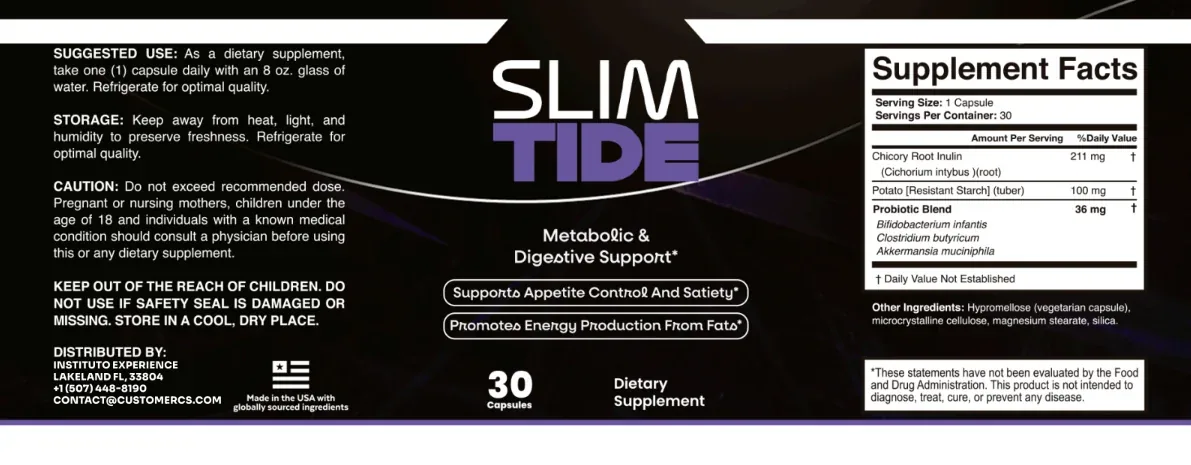
SlimTide's Supplement Facts panel lists three actives in one capsule: 211 mg chicory root inulin, 100 mg potato resistant starch and a 36 mg probiotic blend of Bifidobacterium infantis, Clostridium butyricum and Akkermansia muciniphila. It is a stimulant-free formula, so no caffeine drives the effect. The two fibres are declared by weight; the probiotic blend is not broken down by strain or given in CFU.
- Soluble fibre: the core, for fullness and steadier blood sugar.
- Plant metabolic support + appetite botanicals: the supporting cast.
- Read the label: transparent per-ingredient dosing beats a proprietary blend.
If you want to understand SlimTide ingredients properly, the useful move is to stop looking for a single magic compound and start looking at categories and doses. Weight-support formulas are often marketed around one hero name, but the honest way to read any of them — SlimTide included — is to ask what job each group of ingredients is doing and whether the label tells you how much of each you are actually getting. This article walks through SlimTide's three ingredient categories, explains the role of each, and then hands you a short checklist for reading the panel so you can judge the formula rather than the packaging.
A note on honesty before we start. We are an independent publisher, not the manufacturer, and formulas can be reformulated over time. Everything below describes the categories and the reasoning behind them; the definitive, up-to-date ingredient list is always the Supplement Facts panel on the bottle you receive. Read that first, and treat this as the guide to what you are looking at.
Category one: soluble fibre, the core of the formula
The heart of SlimTide is soluble fibre, and this is the ingredient category with both the clearest mechanism and the strongest evidence. Soluble fibre absorbs water in the stomach and forms a viscous gel, and that gel is what produces the felt effect: it adds physical volume so fullness arrives earlier, and it slows the rate at which the stomach empties so that fullness lasts. As a side benefit of the same slowing, the sugars from a meal enter the bloodstream more gradually, which softens the blood-sugar swings that manufacture afternoon cravings.
This is not an exotic claim. The satiety and glucose effects of soluble fibre are among the better-established findings in nutrition, which is precisely why a fibre-forward design is a reassuring sign rather than a gimmick. If you want the biology in full — the stretch receptors, the gel viscosity, the hormone piece — our companion explainer on how appetite suppressants work in the stomach and bloodstream takes it apart step by step. For the purposes of reading the label, the thing to check is the amount. SlimTide declares 211 mg of chicory root inulin, which is an order of magnitude below the several-gram doses used in the 2024 meta-analysis of chicory inulin-type fructans in the American Journal of Clinical Nutrition, so the honest reading is a genuine ingredient at a small dose rather than a research-strength one.

Category two: potato resistant starch
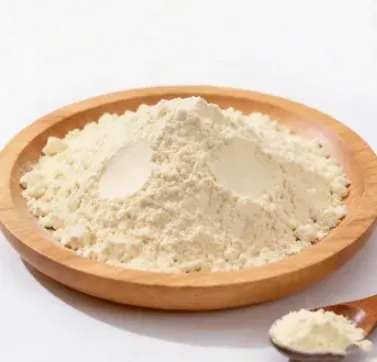
The second declared active is 100 mg of potato resistant starch. Resistant starch is starch that escapes digestion in the small intestine and reaches the colon intact, where gut bacteria ferment it into short-chain fatty acids. This is the part of any weight formula where scepticism is healthiest, and where the label does the most work: the mechanism is real and well described, but 100 mg is a very small amount next to the several grams per day used in the trials that report metabolic effects. That does not make the ingredient worthless — it makes it dose-dependent, and the dose here is modest.
The right way to read this section of the panel is to treat each ingredient as a separate question rather than accepting the group as a whole. A named ingredient at a disclosed amount you can look up is informative. The same ingredient hidden inside a proprietary blend, where only the blend's total weight is printed, is not, because a blend total can be mostly one cheap ingredient with a sprinkle of the interesting ones. This is the single most important habit in supplement literacy, and it applies to SlimTide exactly as it applies to every competitor: prefer the formula that names and doses its ingredients individually over the one that hides them in a blend. SlimTide does this for both fibres and then stops short for the probiotics, which are given a single combined weight.
See SlimTide's Panel For Yourself
The honest way to evaluate any ingredient list is to read the actual Supplement Facts panel and the current price in the same place. SlimTide is a stimulant-free, fibre-forward formula, and the official store shows the full label, the servings and the guarantee. Look at what it declares before you decide.
Category three: the three-strain probiotic blend
The third declared active is a 36 mg probiotic blend naming three organisms: Bifidobacterium infantis, Clostridium butyricum and Akkermansia muciniphila. Naming them is a real point in the label's favour, because probiotic evidence is strain-specific and the NIH Office of Dietary Supplements probiotics fact sheet is explicit that a finding for one strain does not transfer to another. Akkermansia muciniphila is the interesting one here: a 2019 proof-of-concept trial in Nature Medicine found supplementation was safe and associated with improved insulin sensitivity in overweight volunteers.
What the panel does not tell you is how the 36 mg splits between the three organisms, or how many live cells that weight represents. Milligrams measure freeze-dried powder, carriers and dead cells included; colony-forming units measure organisms that are alive and able to multiply, and the two cannot be converted. That gap is the reason the Akkermansia result above cannot be mapped onto this capsule. Our companion piece on reading a probiotic label, CFU versus mg works through why that conversion is impossible from the outside.
The question that matters is never "does the label list an impressive ingredient?" It is "does the label tell me how much of it I am getting?" Transparent dosing is the whole game.
SlimTide ingredients at a glance
| Ingredient category | Role in the formula | Evidence strength | What to check on the label |
|---|---|---|---|
| Chicory root inulin — 211 mg | Prebiotic fibre; feeds gut bacteria, adds gentle satiety | Mechanism well documented; this dose is small | Declared by weight, so it is comparable to studies |
| Potato resistant starch — 100 mg | Fermented in the colon into short-chain fatty acids | Mechanism sound; trial doses are far larger | Declared by weight, well below research amounts |
| Probiotic blend — 36 mg | Three named organisms, including A. muciniphila | Strain-specific; not verifiable at this disclosure | Organisms named, but no per-strain split and no CFU |
| Capsule & non-actives | Delivery and stability | Not applicable | Disclosed, vegetarian, allergen line |
What SlimTide is not: the stimulant question
One of the more useful things about SlimTide's ingredient design is what it leaves out. It is presented as a stimulant-free formula, which means it is not built on caffeine or other stimulants to create its effect. That is a deliberate choice with real consequences for how it feels to take. Stimulant fat-burners produce their sensation — the revved-up, appetite-blunted feeling — by acting on the nervous system, and they come with the familiar downsides: jitteriness, an afternoon crash when the stimulant wears off, and disrupted sleep if taken too late in the day.
A fibre-and-botanical approach works through a completely different route, fullness rather than stimulation, so it sidesteps that whole set of side effects. For anyone sensitive to stimulants, anyone who has been told to avoid them, or anyone who simply does not want their weight-support product to double as a stimulant, this is a meaningful distinction and one worth confirming on the label. It also changes when you can take it: without a stimulant, an evening dose before dinner will not keep you awake, which matters because the evening meal is where many people's appetite is hardest to manage.
A five-point checklist for reading the label
Whatever formula you are weighing up, the same short checklist tells you most of what you need to know, and it works on SlimTide's panel as well as any rival's.
One: is the fibre dosed by weight, and how does it compare to the research? SlimTide is transparent here — 211 mg and 100 mg are printed plainly — but both sit well below the multi-gram doses used in the fibre trials, so read the number rather than the fact that a number exists.
Two: are the ingredients named and dosed individually? Individual amounts you can look up beat a single blend weight every time, because a blend total tells you nothing about the split. SlimTide passes on the two fibres and does not on the probiotic trio.
Three: is there evidence of third-party testing? Independent testing for identity and contaminants is the difference between trusting the label and hoping it is accurate. Look for it, and treat its presence as a genuine plus.
Four: is the allergen and non-active line disclosed? Non-active ingredients are normal; hiding them is not. A clear allergen statement and a named capsule material — here, a vegetarian capsule — are signs of a label written to inform rather than to impress.
Five: does the promise match the mechanism? A prebiotic-and-probiotic formula should be promising steadier appetite and gentle, slow support, not dramatic overnight results — and no dietary supplement is a weight-loss treatment, as the NIH Office of Dietary Supplements review of weight-loss ingredients makes clear. When the front of the box claims more than the ingredients can plausibly deliver, believe the ingredients. If you want to see how that plays out in practice, our look at whether SlimTide actually works in real user reviews weighs the claims against reported experience.

Common questions
What ingredients are in SlimTide?
SlimTide declares three actives rather than a single hero compound: 211 mg chicory root inulin, 100 mg potato resistant starch and a 36 mg blend of Bifidobacterium infantis, Clostridium butyricum and Akkermansia muciniphila. It is presented as a stimulant-free formula, so it does not rely on caffeine or other stimulants for its effect. Because formulas can be updated, the label on the bottle you receive is always the authoritative list, and it is the one to read before you buy.
Are SlimTide's ingredients evidence-based?
The strongest evidence sits with the prebiotic fibre component, whose effect on fullness, slower gastric emptying and gut bacterial populations is well documented. The probiotic side has a more mixed evidence base that varies by strain and, crucially, by dose, which is why transparent per-ingredient amounts matter more than a long list of names. Evidence-based is best judged ingredient by ingredient against the amount actually declared, not by the reputation of the category as a whole.
Does SlimTide contain stimulants or caffeine?
SlimTide is presented as a stimulant-free formula, which means it is not built on caffeine or other stimulants to create its effect. That is a deliberate design choice: it works through fullness and satiety rather than by revving up the nervous system, so it avoids the jitters, afternoon crash and sleep disruption that stimulant fat-burners are known for. If you are sensitive to stimulants or take them out for medical reasons, still confirm against the label on your bottle, since that panel is the definitive source.
Are there allergens or fillers in SlimTide?
SlimTide carries badges for gluten-free, non-GMO and vegetarian capsules, and the label lists the non-actives as hypromellose (the vegetarian capsule), microcrystalline cellulose, magnesium stearate and silica. Some non-active ingredients are normal and necessary, so their presence is not a red flag; what matters is that they are disclosed rather than hidden. If you have a specific allergy, read the full ingredient statement and the allergen line on the bottle you receive, and when in doubt ask the manufacturer directly rather than relying on a summary.
Related reading
References and further reading
- U.S. Food and Drug Administration — how dietary fibre is defined and declared on labels
- NIH Office of Dietary Supplements — weight-loss ingredients and the state of the evidence
- Mayo Clinic — soluble versus insoluble fibre and their effects
- Harvard T.H. Chan School of Public Health — fibre, satiety and why the dose matters
- U.S. Pharmacopeia — what third-party supplement verification actually checks
General information, not medical advice. These statements have not been evaluated by the Food and Drug Administration, and no dietary supplement is intended to diagnose, treat, cure or prevent any disease. The Supplement Facts panel on your bottle is the authoritative ingredient list; speak to a qualified healthcare professional before changing what you take, especially if you use prescription medication.
Affiliate link. Slimtiade Label Notes earns a commission on purchases made through it, at no extra cost to you. We are not the manufacturer.